WOW! · 1977 · Signals
The Wow! Signal Might Not Be Aliens. The New Idea Is Stranger.
A 2024 proposal says a cold hydrogen cloud flared like a natural laser. The 2025 re-analysis was still a preprint when we made the video, and the signal has never repeated.
 Watch on YouTube
The case
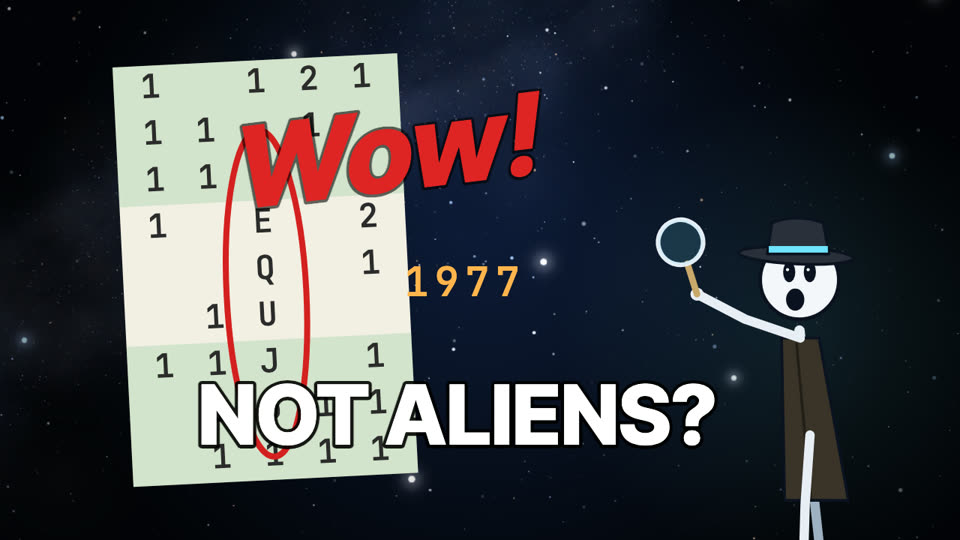
The Wow! signal was a strong narrowband radio burst recorded by Ohio State's Big Ear telescope on 15 August 1977, right beside the 1420 MHz hydrogen line long proposed for interstellar communication. It filled the telescope's 72-second window and has never been detected again. In 2024 Abel Méndez and colleagues proposed that a cold hydrogen cloud, hit by a burst of radiation (perhaps a magnetar flare), briefly flared like a natural laser; archival Arecibo data showed similar narrowband signals about a hundred times fainter. Their 2025 reanalysis of the original Ohio SETI records found the signal even brighter than earlier estimates, at a slightly different frequency, from a tighter patch of sky, with TV stations, satellites and the Sun not fitting. The new analysis is a preprint, and the case remains open.
Sources
- Wikipedia, 'Wow! signal' (detected 15 Aug 1977 by Ohio State's Big Ear; 72-second observing window; narrowband near the 1420 MHz hydrogen line; never detected again; Cocconi & Morrison's 1959 proposal of the hydrogen line for interstellar communication).Supports: 1977, Ohio, 72 s window, hydrogen line, proposed SETI frequency, never repeated, follow-up searches found nothing.
- Mental Floss, '6EQUJ5: The Wow! Signal'.Supports: Jerry Ehman reviewed the printout, circled 6EQUJ5 and wrote 'Wow!'; 6EQUJ5 encodes intensity over time; repeat observations found nothing.
- ExplorersWeb, 'Exploration Mysteries: The Wow! Signal'.Supports: Big Ear watched the same spot for a month and again a year later and found nothing; comet hypothesis (2016-17) dismissed.
- Méndez, A., Ortiz Ceballos, K., Zuluaga, J. I. (2024). Arecibo Wow! I: An Astrophysical Explanation for the Wow! Signal. arXiv:2408.08513 (submitted to ApJ).Supports: Hydrogen-line brightening in cold HI clouds triggered by a strong transient source such as a magnetar flare or SGR; maser flare/superradiance; Arecibo 2020 data show similar narrowband signals two orders of magnitude weaker in multiple locations.
- Méndez, A., et al. (2025). Arecibo Wow! II (reanalysis of archival Ohio SETI data). arXiv:2508.10657, v1 14 Aug 2025; comments: 'To be submitted to ApJ after incorporating feedback'.Supports: Peak flux density exceeding 250 Jy; frequency 1420.726 ± 0.005 MHz; narrower, slightly displaced position; cold HI clouds can produce similar narrowband signals; preprint status.
- Tomaswick, A. (Universe Today), 'The "Wow!" signal gets an update: It was even stronger than we thought', Phys.org, 25 Aug 2025.Supports: Over 75,000 pages of original data run through OCR with human validation; previous estimates 54-212 Jy; frequency changed from 1420.4556 to 1420.726 MHz; no TV stations, satellites or Moon fit; Sun unlikely; HI cloud most likely.
- Anderson, P. S., 'The Wow! Signal: New analysis closes in on mysterious source', EarthSky, 24 Aug 2025 (quotes Abel Méndez).Supports: Submitted to ApJ for peer review; Méndez: 'This study doesn't close the case. It reopens it'.
- Cocconi, G., Morrison, P. (1959). Searching for Interstellar Communications. Nature 184.Supports: The 1420 MHz hydrogen line proposed as a natural frequency to search for interstellar signals.
What this video does not claim
- No claim that aliens are ruled out; framed as 'maybe not'.
- No claim the 2025 paper is peer reviewed; stated as a preprint.
- No claim about the Big Ear site's later use (only secondhand sourcing).
- Jerry Ehman is not named or depicted as a specific person; the stick figure is a generic recreation labelled RECREATION.
About the pictures
Everything you see is an animated explainer. Recreations are labelled ILLUSTRATION on screen and are not evidence. Real people are drawn only as generic figures, never with an invented face. The narration is a synthetic voice.
Spotted an error? Tell us in the YouTube comments, with a source.