FRANKLIN · 1845 · Cold Files
Britain Called Them Liars. 170 Years Later, DNA Proved the Inuit Right.
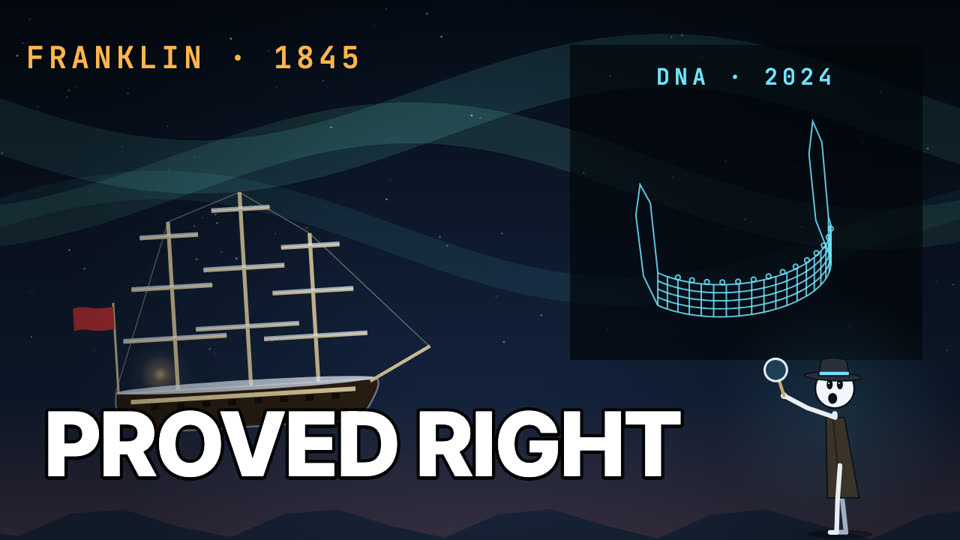
The jawbone is Captain James Fitzjames's (DNA match, 2024), and its cut marks match what Inuit witnesses reported. Most of Franklin's crew still have no name.
 Watch on YouTube
The case
In 1845 Sir John Franklin led HMS Erebus and HMS Terror, with 129 men, to find the Northwest Passage. Trapped by sea ice off King William Island in September 1846, they lost Franklin in June 1847; a note left in a cairn records that the ships were deserted in April 1848 and 105 survivors set off on foot. None came home. In 1854 Inuit told explorer John Rae that the men had starved and some had resorted to cannibalism. Britain was outraged, and an 1854 article in Charles Dickens's Household Words dismissed the Inuit accounts as unreliable. Bones later found at site NgLj-2 on King William Island carried cut marks, and in 2024 a Y-chromosome DNA match with a living descendant identified one jawbone as Captain James Fitzjames of HMS Erebus; it also bears cut marks. In 2026 four more sailors were identified, bringing the total to six of 129.
Sources
- University of Waterloo news release, 'Another Franklin expedition crew member has been identified', 24 Sept 2024; reporting Stenton, Fratpietro & Park, 'Identification of a Senior Officer from Sir John Franklin's Northwest Passage Expedition', Journal of Archaeological Science: Reports (2024).Supports: Mandible from site NgLj-2, King William Island identified as James Fitzjames of HMS Erebus via a Y-chromosome DNA match with a living descendant; 451 bones from at least 13 sailors; mandible shows multiple cut marks, his body was subject to cannibalism; Keenleyside (1997) found cut marks on nearly one quarter of the bones, corroborating 1850s Inuit accounts; 105 survivors left the ships in April 1848, none survived; Stenton: neither rank nor status was the governing principle.
- Wikipedia, 'James Fitzjames'.Supports: Captain of HMS Erebus; born 27 July 1813, died c. 1848; mandible identified by DNA in 2024 (second expedition member identified after John Gregory, 2021); cut marks consistent with cannibalism.
- Wikipedia, "Franklin's lost expedition".Supports: Departed 1845 with HMS Erebus and HMS Terror, 129 men after discharges; beset 12 Sept 1846 off King William Island; Franklin died 11 June 1847 (Victory Point note); note of 25 April 1848: ships deserted 22 April, 105 souls under Crozier, heading for Back's Fish River; Rae met Inuit in April 1854 who reported starvation and cannibalism; cut marks supported Rae's report.
- Wikipedia, 'John Rae (explorer)'.Supports: Rae obtained credible information from local Inuit (1854); report caused outrage; Lady Franklin enlisted Charles Dickens, who attacked the report in Household Words.
- 'The Lost Arctic Voyagers', Household Words no. 245, 2 Dec 1854 (attributed to Charles Dickens), transcription at Canadian Mysteries.Supports: Argues the Inuit accounts are unreliable ('the very loose and unreliable nature of the Esquimaux representations') and that cannibalism by the crews was highly improbable.
- University of Waterloo news release, 'DNA matches identify four more sailors from Franklin expedition', 6 May 2026 (papers in Journal of Archaeological Science: Reports and Polar Record).Supports: William Orren, David Young, John Bridgens (Erebus) and Harry Peglar (Terror) identified; total identified now six; researchers encourage other descendants to connect with them.
What this video does not claim
- No claim that Fitzjames was the first person cannibalised or the first officer; only that his jaw carried cut marks (Waterloo release).
- No claim about how or exactly when Fitzjames died; no depiction of remains, injuries or cannibalism.
- No claim that lead poisoning caused the disaster (contested); left out of the Short.
- The Victory Point note is shown as a recreation in our own lettering, not a copy of the original document.
- Dickens's position is summarised from the 1854 article attributed to him, quoting three words; the Inuit figures are generic and labelled ILLUSTRATION.
- No named living relative (the DNA donor is not named).
About the pictures
Everything you see is an animated explainer. Recreations are labelled ILLUSTRATION on screen and are not evidence. Real people are drawn only as generic figures, never with an invented face. The narration is a synthetic voice.
Spotted an error? Tell us in the YouTube comments, with a source.